Taming, pet battles, breeding, and evolution.
Pet System
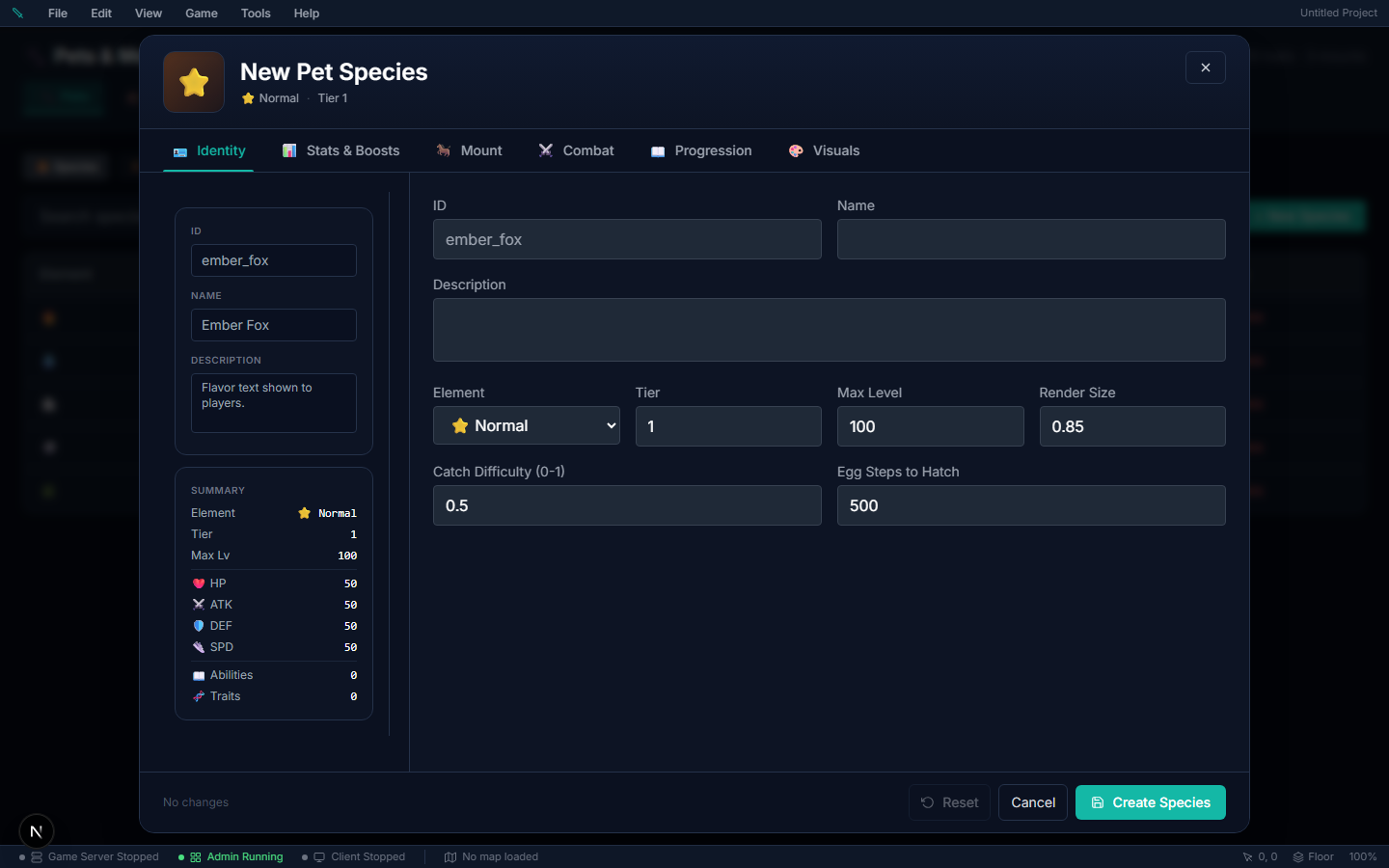
ED5 includes a full pet system inspired by Pokémon — taming wild creatures, turn-based battles, breeding, and evolution.
Taming
Players capture wild mobs using taming items:
- Lower HP = higher chance to tame
- Higher Taming skill = better base chance
- Different mobs may need different taming items
Pet Following
Tamed pets follow their owner within 2 tiles and automatically teleport if they fall more than 10 tiles behind.
Pet Battles
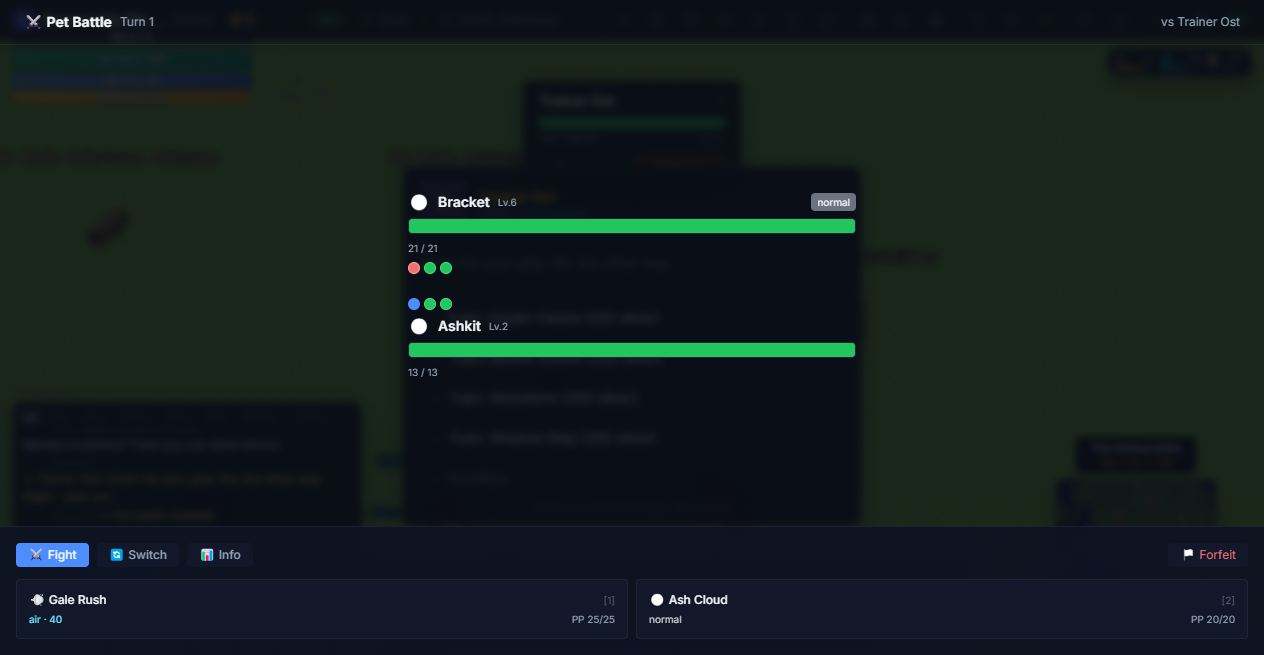
Turn-based combat between two teams of pets. You can battle another player, or challenge a trainer NPC you have authored.
1. One side challenges the other 2. Each side brings a team (up to 3 pets) 3. Each turn both sides pick an ability 4. Pets can be switched mid-battle 5. Last pet standing wins
Trainer NPCs (gym battles)
A trainer is an ordinary NPC with a battle team attached. Players walk up, select them, and press Battle on the target panel.
Where to author it
1. Open Database → Pets & Mounts → Battle Teams and create a team. 2. Add pets to its roster: species, level, nickname, up to 4 abilities, and the slot order (the lead pet fights first). 3. Open Database → NPCs, pick the NPC, and set its Pet Battle Team.
Team fields
| Field | What it does |
|---|---|
| Format | How many pets fight at once — 1v1, 2v2 or 3v3. |
| Roster size | How many pets each side may bring. |
| Difficulty | How the trainer plays: Random picks any move, Basic picks the strongest, Smart also retreats a losing pet. |
| Scene | The stage art. Leave empty to pick one from the zone. |
| Challenge / win / lose dialogue | What the trainer says before and after. |
| First-clear rewards | Gold, taming XP, pet XP and items, paid once. |
| Rematch | Whether they can be fought again, the cooldown in hours, and the smaller repeat reward. |
| Heal challenger's pets | Tops the player's team up before the fight, so a trainer tests your team rather than how worn down it is. |
Roster fields
| Field | What it does |
|---|---|
| Pet | The species this trainer fields. |
| Level | Sets its stats. |
| Nickname | Shown in battle instead of the species name. |
| Abilities | Up to 4. Leave empty to use the species' own moves for that level. |
| Slot order | Lead pet first; pets beyond the format size wait on the bench. |
Gotchas
- The Battle option only appears on NPCs that have a team attached — if it is
- The player needs at least one pet of their own, or the challenge is refused.
- Trainer battles need the Pet Battles feature flag switched on.
Battle presentation
Pet battles can be presented two ways, and the choice is yours per world.
Where to author it: Database → Combat → Pet Battle → Default Battle Mode.
| Mode | What the player sees |
|---|---|
| Real-time auto battle | A battle circle is drawn around the two handlers in the world. The pets fight there on a timer, following each pet's weighted auto plan, while a compact bar along the bottom lets you override the next action, switch, use an item or forfeit. The world and its HUD stay visible. |
| Turn based | A full-screen stage. Both pets stand on platforms facing each other and play their own animations, with health plates, roster pips and a move grid. The world HUD steps out of the way. |
Switching the mode changes only how a battle is presented and paced. The rules — damage, accuracy, type effectiveness, status conditions, PP, fainting, switching and rewards — are identical in both.
Giving your pets a face
Every pet species needs a sprite of its own. Open **Database → Pets & Mounts → Species, pick the species, open the Visuals** tab, and choose an animated sprite — the same picker the character and NPC editors use.
This matters more than it looks. A species with an empty Visuals tab still battles correctly, but it has nothing to draw: it shows as a plain marker in the real-time circle and as an empty platform on the turn-based stage. The battle works and looks broken. If your pets are invisible in battle, this is why.
- Pets are stationary on the turn-based stage and face each other — the
- Each battler is scaled to fit the stage, so species with different sheet sizes
- Wider formats are the same stage with more battlers: pets line up on their
Battle scenes
A scene is the stage art behind a turn-based battle: background, midground, platforms for each side, a tint colour and opacity, and music.
A battle picks its scene in this order:
1. The scene set on the trainer's battle team. 2. The highest-priority scene whose match rules fit the zone or biome. 3. A built-in stage drawn by the engine.
That last step means you never get an empty screen — a world with no scenes authored still gets sky, ground and platforms. Author scenes to replace it.
Damage Formula
Pet battle damage uses a dedicated formula separate from the main combat system — damage scales with level, move power, and the attacking/defending pet's stats.
Type Effectiveness
A configurable type chart determines super-effective and not-very-effective matchups, just like Pokémon.
Pet Status Conditions
| Status | Effect |
|---|---|
| Poison | Loses HP each turn |
| Burn | Loses HP each turn, reduced attack |
| Sleep | Cannot act for N turns |
| Paralyze | 25% chance to skip turn |
| Freeze | Cannot act, thaws after N turns |
| Confusion | May hit self instead |
Pet Stats
Each pet has 6 stats influenced by:
- Base stats — defined by the species
- IVs (Individual Values) — random 0–31 per stat, set at birth or tame
- EVs (Effort Values) — earned through battles
- Nature — personality that boosts one stat and reduces another
- Level — scales stats as the pet levels up
Abilities
Each pet can learn up to 4 abilities with PP (Power Points). When PP runs out, the move can't be used until restored.
Breeding
Two compatible pets can breed to produce an egg:
- IVs are inherited from parents
- Species is determined by the mother
- Abilities may be inherited or randomly picked
- Eggs hatch after the player walks a configurable number of steps
Evolution
Pets can evolve at level thresholds into stronger forms with:
- New visual appearance
- Higher base stats
- New learnable abilities
- Possible type changes
Mounts
Pets above a configured size threshold can serve as mounts:
- Configurable speed bonus
- Terrain restrictions (water mounts, flying mounts)
- Dismount on taking damage (optional)
- Summoning animation and mount-up delay