Build HUD widgets, chat commands, and client features.
Client Plugins
Client plugins are JavaScript files that run in the player's browser. They can create HUD widgets, register local chat commands, and communicate with server plugins.
How They Work
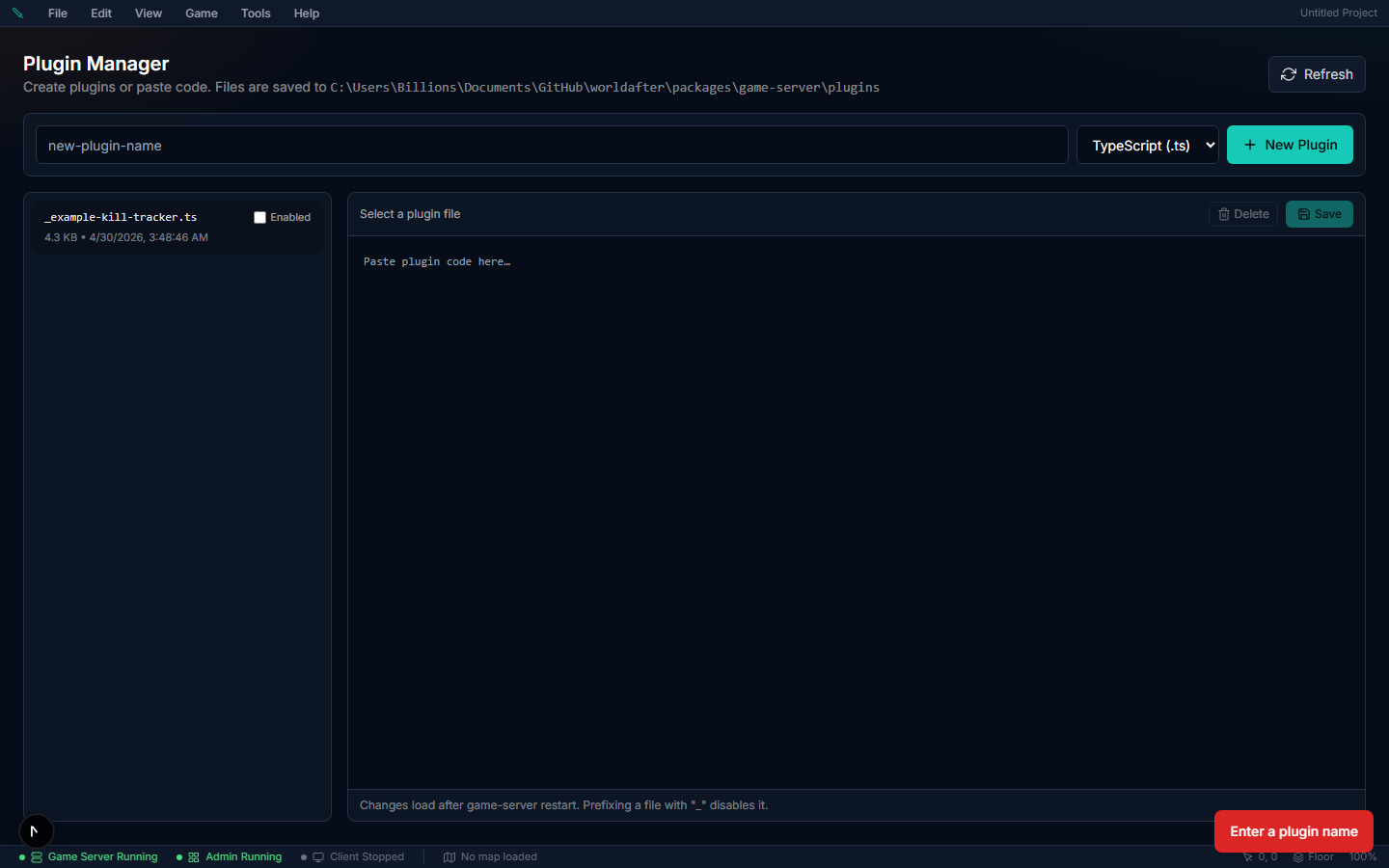
1. Create a .js file in the Plugin editor (Client tab) or the client-plugins/ folder
2. When a player connects, the server sends all client plugins to their browser
3. Each plugin runs with a ctx object and interacts with the game only through it
Important: Client plugins must be plain JavaScript (.js).
> Sandbox: by default (sandboxedClientPlugins, on), a client plugin runs inside a QuickJS-WASM isolate with no DOM, window, or globals — it reaches the page only through ctx. In this mode import lines are stripped and modern (ES2020) syntax is fine. If the sandbox flag is turned off, a legacy path runs the code with new Function and full DOM access — only there does ES5-only advice apply. Write for the sandbox: use ctx, not the DOM. Unlike server plugins, the client ctx is not capability-gated today.
Game State
var state = ctx.getState();
// Returns: selfId, selfName, selfPosition, selfHp, selfMaxHp,
// selfMp, selfMaxMp, selfSilver, accountGold, currentZoneId,
// currentZoneName, connected, isDead, isMounted, playerLevel,
// inventory, equipment, skills, activeEffects, activeQuests,
// party, guild, chatMessages, entities, survival, environment
ctx.onStateChange(function() {
  var state = ctx.getState();
  // Update your widgets here...
});
HUD Widgets
Create floating UI elements on screen:
var widgetId = ctx.createWidget({
  html: "<div>My Widget</div>",
  anchor: "top-right",
  position: { x: 16, y: 80 },
  width: 200,
  height: 100,
  visible: true,
  draggable: true,
  zIndex: 100,
  css: "background:rgba(0,0,0,0.8);color:white;" +
       "padding:10px;border-radius:8px;",
  onClick: function() {
    ctx.addLocalChatMessage("Widget clicked!");
  },
});
ctx.updateWidget(widgetId, { html: "<div>Updated!</div>" });
ctx.removeWidget(widgetId);
Widget Options:
| Property | Type | Default | Description |
|---|---|---|---|
html | string | required | Inner HTML content |
css | string | — | Inline CSS style |
anchor | string | "top-left" | Screen anchor: top-left, top-right, bottom-left, bottom-right, center |
position | {x, y} | {0, 0} | Offset from anchor |
width | number | auto | Width in pixels |
height | number | auto | Height in pixels |
visible | boolean | true | Show/hide |
draggable | boolean | false | User can drag the widget |
zIndex | number | 100 | Layering order |
onClick | function | — | Click handler |
Chat Commands
ctx.addChatCommand("pos", function(args) {
  var state = ctx.getState();
  ctx.addLocalChatMessage(
    "[Plugin] X=" + Math.round(state.selfPosition.x) +
    " Y=" + Math.round(state.selfPosition.y)
  );
});
Server Communication
Send and receive data from server plugins:
// Send to server
ctx.send("my-channel", { action: "request-data" });
// Receive from server
ctx.on("my-channel", function(data) {
  ctx.addLocalChatMessage("Server says: " + data.message);
});
Timers
var cancel = ctx.setInterval(function() {
  // runs every second
}, 1000);
ctx.setTimeout(function() {
  ctx.addLocalChatMessage("Timer fired!");
}, 5000);
More client APIs
Beyond the above, the client ctx also gives you:
ctx.pluginName;                       // this plugin's name (read-only)
ctx.log.info("loaded");               // client logger: info / warn / error (no debug)
// Listen to raw server messages by type (not just plugin channels):
var off = ctx.onServerMessage("EntityUpdate", function (msg) { / ... / });
off();                                // every subscribe returns an unsubscribe fn
ctx.on, ctx.onStateChange, ctx.addChatCommand, ctx.setInterval, and ctx.setTimeout all return a teardown function too — call it to stop listening.
Restrictions
- No direct DOM access — build UI only through
createWidget. Widget HTML is sanitized:<script>, inlineon*handlers,javascript:URLs, and<iframe>/<object>/<embed>/<form>/<meta>/<link>/<base>are stripped. Use theonClickoption for interactivity, not inline handlers. - No access to game engine internals — only the
ctxAPI. - Server communication is named channels carrying arbitrary JSON — not schema-validated, so validate payloads on the server.
- In the sandboxed path, a widget's
onClickreceives no arguments (theMouseEventis only available on the legacy non-sandboxed path).